Technical Resources for Life Insurance Advisors
As a retired Canadian Life Insurance Advisor spanning 40 years, my career has taken me from building products for the largest global insurance companies and leading sales forces focused on high net worth clientele. Today, I write about technical life insurance on LinkedIn and as a Contributor for Advisor.ca and InvestmentExecutive.com.
This website serves as a premium collection of my papers, mathematical analysis and modelling, frameworks, and resources to help Canadian Advisors in their technical applications on policies and disclosures to strengthen the financial and emotional peace of mind of families.
Featured Resource
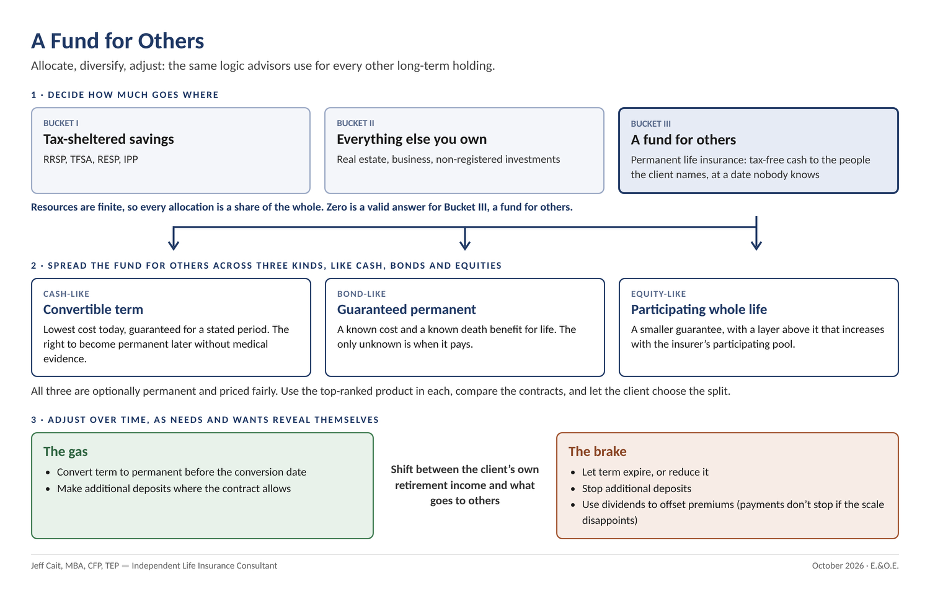
The Diversified Portfolio Approach applies the three principles, and each slide turns on one in particular.
One — the Allocation Method. Three buckets: tax-sheltered savings, everything else you own, and a guaranteed tax-free transfer to the people you name. How much belongs in each? Compared to what, before any product exists. Zero is printed on it as a valid answer.
Two — the DPA. A diversified portfolio approach. One outlay, three shapes, side by side. Compared to what, applied to product. This is the page above.
Three — the ROI. What the same money returns, against what it would otherwise do. Compared to what, expressed as a rate, with guaranteed values kept separate from illustrated ones.
Four — the Product Rankings. Why these contracts. The criteria are contract features — conversion wording, the guarantees themselves, protection of the pool — so this is Review the policy contract, with the weights published in advance and open to challenge.
Five — the Holding Statement. Put it in writing, for a reader who is not in the room and may not be born yet.
Five pages is the whole engagement. What follows is one part of page two.
The Latest Resources
Almost everything in a financial plan is an estimate. Life insurance is the one place a genuine guarantee can be bought.
Markets, longevity, health, timing — a sound financial plan is built on these, and they are well-founded estimates, but estimates still. The guaranteed death benefit is the one element that is not: a fixed sum, tax-free, paid at a date certain to come but impossible to predict when.
That is what makes it the natural place to begin measuring. You can measure almost anything; what a fixed point gives you is a measurement that means something. Start there, and a family can see the guaranteed and the non-guaranteed side by side and decide how much of their wealth, if any, belongs in each.
So the question is not “is life insurance better than the alternatives?” It is “how much of this certainty do we want in our own plan, and what is it worth paying for?” And in Canada today, for the life insurance a family actually buys, that certainty can reliably be had.
The model/acronym is borrowed from Generally Accepted Accounting Principles (GAAP). Since roughly 1940, GAAP has been the published standard for how accountants prepare financial statements — designed to ensure transparency, consistency, and comparability so users can trust the results. They made financial statements comparable. Provided through a method you could trust, intended to reveal what something is. GAAP made people trust the comparison. It wasn’t perfect. Progress not perfection.
GALIP applies the same aim to life insurance. Applications include acknowledging you understand what you just read. GALIP is what is there for the consumer who wants to understand more. GAAP turns financial reporting into a story. Every annual statement tells a story. To whom? Can you trust it?
Like GAAP, GALIP is a published standard. It consists of five principles.
Thursday morning, May 8th, 9 AM Eastern. Week 18 was supposed to launch our "Optimal Insurance Solutions" section with traditional needs analysis. Instead, it became the moment everything changed. What should have been routine became revolutionary when the Tribe challenged the fundamental question we'd been asking families for decades.
"Good morning, everyone," I began, settling into what I expected would be a standard session on needs analysis methodology. "Today we start exploring optimal insurance solutions, beginning with the foundation of professional practice: helping families determine how much coverage they need."
I had my five slides prepared. Traditional approach, but systematic. The framework looked solid on paper: Why insure? Who needs how much? How long? What do you want? Where does it fit?
But the Tribe had other plans.